Arthur Fleming
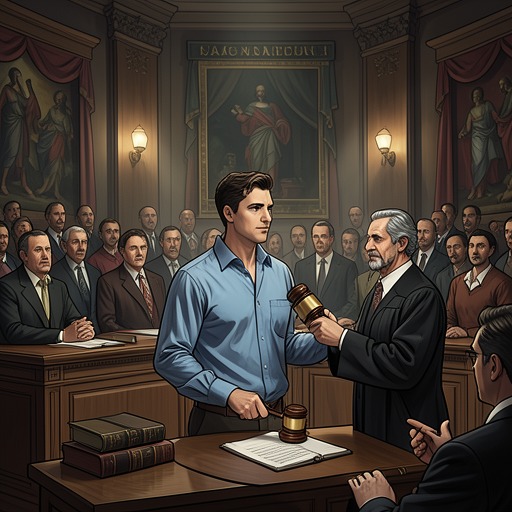
In Cold BloodArthur Fleming, a seventy-one-year-old former mayor of Garden City, was appointed to represent Perry Smith when Smith and Richard Eugene Hickock said they could not afford lawyers. A short man known for conspicuous neckwear, Fleming was an experienced local attorney whose professional life had been more comfortably occupied with land deeds than criminal cases. He resisted the appointment, but accepted that the court had the authority to require his service. In the trial that followed, he had to defend a client who had confessed and whose guilt the prosecution supported with substantial evidence; his choices therefore centered on testing the state’s account, presenting what humanizing evidence he could, and asking the jury to spare Smith’s life.
Appointment and the Problem of the Defense
On January 11, Smith recorded in his diary that he had a lawyer, describing Fleming as an old man with a red tie. The detail captures the visible impression Fleming made, while the circumstances of his appointment show the limited position from which he began. He had told Judge Roland H. Tate that he did not wish to serve, but would do so if appointed. Harrison Smith, assigned to Hickock, accepted with less resistance. The two local attorneys thus entered a highly visible case not as privately retained specialists but as court-appointed counsel for defendants without funds.
The defense faced a difficult evidentiary landscape. Smith had made a confession, and Hickock had signed one accusing Smith of killing all four members of the Clutter family. The prosecution also possessed other evidence connecting the men to the crime. Fleming’s task was not simply to deny the case’s central facts: he had to address the defendants’ responsibility and the penalty the state sought. His later account of the appointment emphasized that the case demanded extensive work, although the circumstances left his conduct open to scrutiny.
Cross-Examining Floyd Wells
Fleming’s questioning of Floyd Wells brought the origins of the robbery plan into the courtroom. Wells had provided information about Herbert Clutter’s farm that helped set the scheme in motion. After the prosecution had used his testimony to establish substantial premeditation, Fleming turned to a question the state had avoided: whether Wells himself had any moral responsibility for the plot.
He asked whether Wells had tried to discourage Hickock from coming to the farm to rob and kill the family. Wells said he had not. Fleming then pursued whether Wells had meant to make Hickock believe there was a safe at the house. That line of questioning shifted attention from the two defendants alone to the chain of information and choices that preceded the murders. It did not erase the defendants’ acts, but it pressed the jury to consider how the plan had been encouraged and what role its source had played.
Witnesses for Smith
Fleming presented four witnesses: the Reverend James E. Post, Joe James, Donald Cullivan, and Dr. W. Mitchell Jones. The first three were offered as character witnesses, expected to describe personal qualities that could complicate the image of Smith as nothing but a criminal. The prosecution repeatedly objected to favorable personal testimony as irrelevant, and the court limited what the witnesses could say.
Joe James, an Indigenous friend who had traveled for more than a day and two nights from the Far Northwest to attend, testified that Smith had lived with him intermittently for over two years and had been well liked in the neighborhood. The state stopped him when he tried to say that Smith had never behaved badly to his knowledge. Donald Cullivan, who had known Smith in the Army, managed only a brief favorable assessment before the prosecution intervened. Their testimony offered the jury glimpses of Smith’s life beyond the charged crime, but the narrow scope allowed them little room to develop those accounts.
The Reverend Post described a different kind of evidence: an act of religious and artistic expression during Smith’s imprisonment at the Kansas State Penitentiary. He testified that Smith had brought him a pastel head-and-shoulders portrait of Jesus and offered it for the prison chapel. The painting had remained on the walls of Post’s office. Fleming tried to provide photographs for the jurors, but the prosecution objected and Judge Tate halted the effort. The episode shows both Fleming’s attempt to make Smith’s capacities visible and the limits imposed on that attempt in court.
Dr. Jones was recalled to address Smith’s mental responsibility, with Fleming asking whether, on the basis of his examination and conversations, the doctor had an opinion about whether Smith knew right from wrong at the time of the crime. The court required a yes-or-no answer. Together, the witnesses covered personal character, religious art, and psychiatric assessment, but none could displace the central facts the prosecution had assembled.
The Appeal for Mercy
In his closing argument, Fleming made a religious appeal against execution. He argued that a human being was more than a body and that the state should not destroy the life understood as the dwelling place of the soul. The speech was gentle in tone rather than a forceful attack on the prosecution’s proof. Its purpose was to ask the jury to distinguish between finding Smith guilty and deciding that the state should kill him.
Hickock’s lawyer, Harrison Smith, also urged mercy, building his argument around the moral and social costs of capital punishment. The prosecution answered that both defendants were equally guilty regardless of who had fired the shotgun, and urged the maximum penalty. Fleming’s argument therefore faced not only a strong case for conviction but a prosecution that treated the death sentence as necessary to protect the public. The jury’s decision would reveal how little room the defense’s appeal for mercy could secure.
Venue and Questions About Counsel
Fleming’s decisions became a subject of dispute during a later hearing concerning the defendants’ appeals. Asked why he had not sought a change of venue, he explained that local ministers, including Reverend Cowan, had spoken against capital punishment. He also recalled that a brother of Bonnie Clutter had made a public statement indicating that the defendants should not be put to death. Fleming believed these expressions suggested that local jurors might be more lenient about the penalty than jurors elsewhere in the state.
The hearing also examined whether Fleming and Harrison Smith had consulted their clients sufficiently, whether they had prepared the defense properly, and whether damaging remarks had been made to reporters. Fleming said that he had given the case more time than he gave most cases and had worked to the best of his ability. Harrison Smith disputed the premise that counsel had waived a preliminary hearing, explaining that neither attorney had yet been appointed when that occurred. Fleming’s explanation about venue thus formed part of a broader defense of decisions made under difficult circumstances, rather than an uncontested account of the representation.
The federal judges reviewing the case later placed those decisions in the context of what counsel knew when they accepted their appointments: both defendants had confessed, neither seriously claimed in the state courts that the confessions were involuntary, and prosecutors held additional evidence of guilt. That assessment does not make Fleming’s defense unconstrained or remove the questions raised about it. It clarifies the central pressure of his role: he was asked to defend Smith’s interests in a case where the evidence and Smith’s own admissions sharply narrowed the available arguments, while the consequences at stake were life and death.